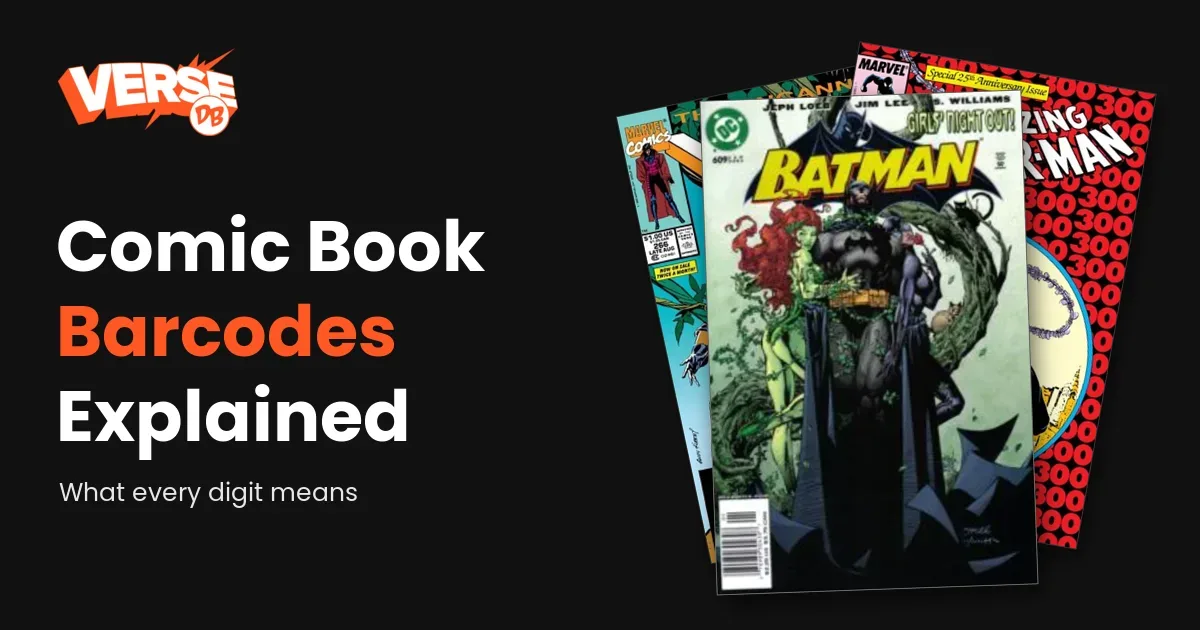
Comic Book Barcodes Explained: What Every Digit Means
Many modern comics carry a main barcode with a smaller add-on beside it, on the front or back cover. The main code identifies a product or comic title. The smaller code often helps identify the issue, cover variation, and printing, but publishers haven't always used the same conventions.
What's Actually on a Comic Book Barcode
The main barcode on many single issues is a 12-digit UPC-A. Its number has three parts:
- A UPC company prefix assigned through GS1
- An item reference assigned by the publisher
- A final check digit calculated from the other eleven digits
The company prefix and item reference together occupy eleven digits, but their individual lengths vary. You can't always split them into a five-digit publisher code and a five-digit series code. The first digit isn't a category label meaning "comic book." GS1's guidance explains the variable-length structure.
For the check digit, multiply alternating digits of the first eleven by 3 and 1, starting with 3 on the left. Add those results, then find the digit needed to reach the next multiple of ten. If the sum already ends in zero, the check digit is zero.
A publisher may use the same base UPC across multiple issues and distinguish them with the add-on. That isn't guaranteed across every edition, format, or reprint, and the number alone doesn't spell out a series title.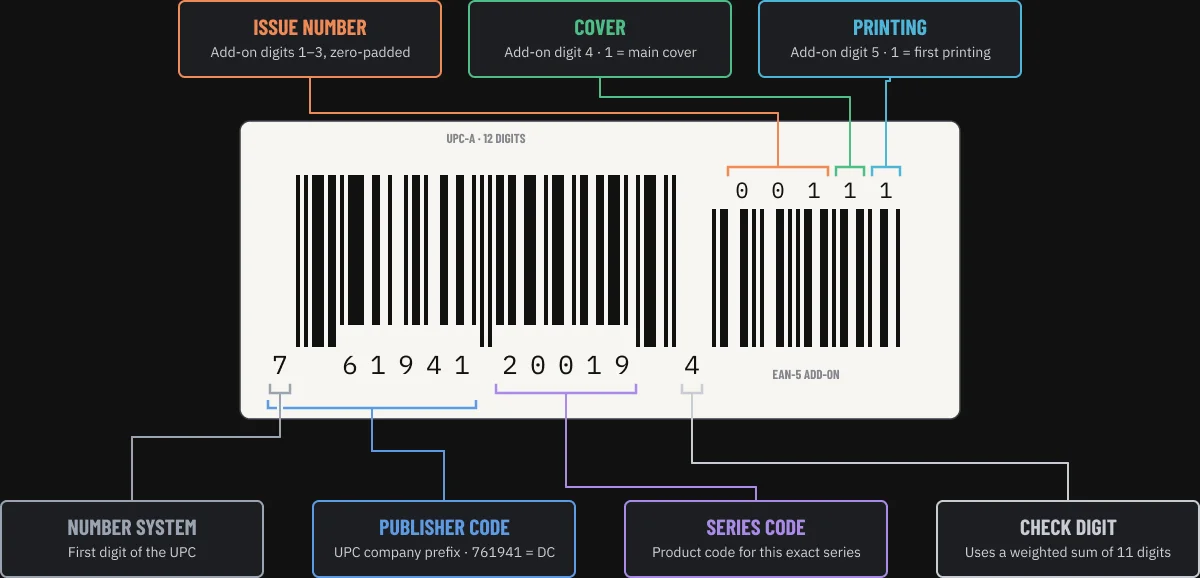
What the Five-Digit Add-On Usually Means
On many modern single issues, the smaller five-digit add-on describes the comic rather than its price. A common convention is:
- Digits 1-3 indicate the issue number
- Digit 4 indicates the cover variation
- Digit 5 indicates the printing
Under that convention, 00111 reads as issue #1, cover 1, first printing. Changing the fourth digit gives 00121: cover 2 of the same issue, also a first printing. Changing the fifth digit instead gives 00112: a second printing of cover 1. The fourth digit distinguishes covers; the fifth distinguishes printings. A cover code doesn't identify the artist or guarantee a particular Cover A or Cover B label.
Diamond's barcode guidance helped establish this format for the direct market. For more background, see how comic books are distributed and sold.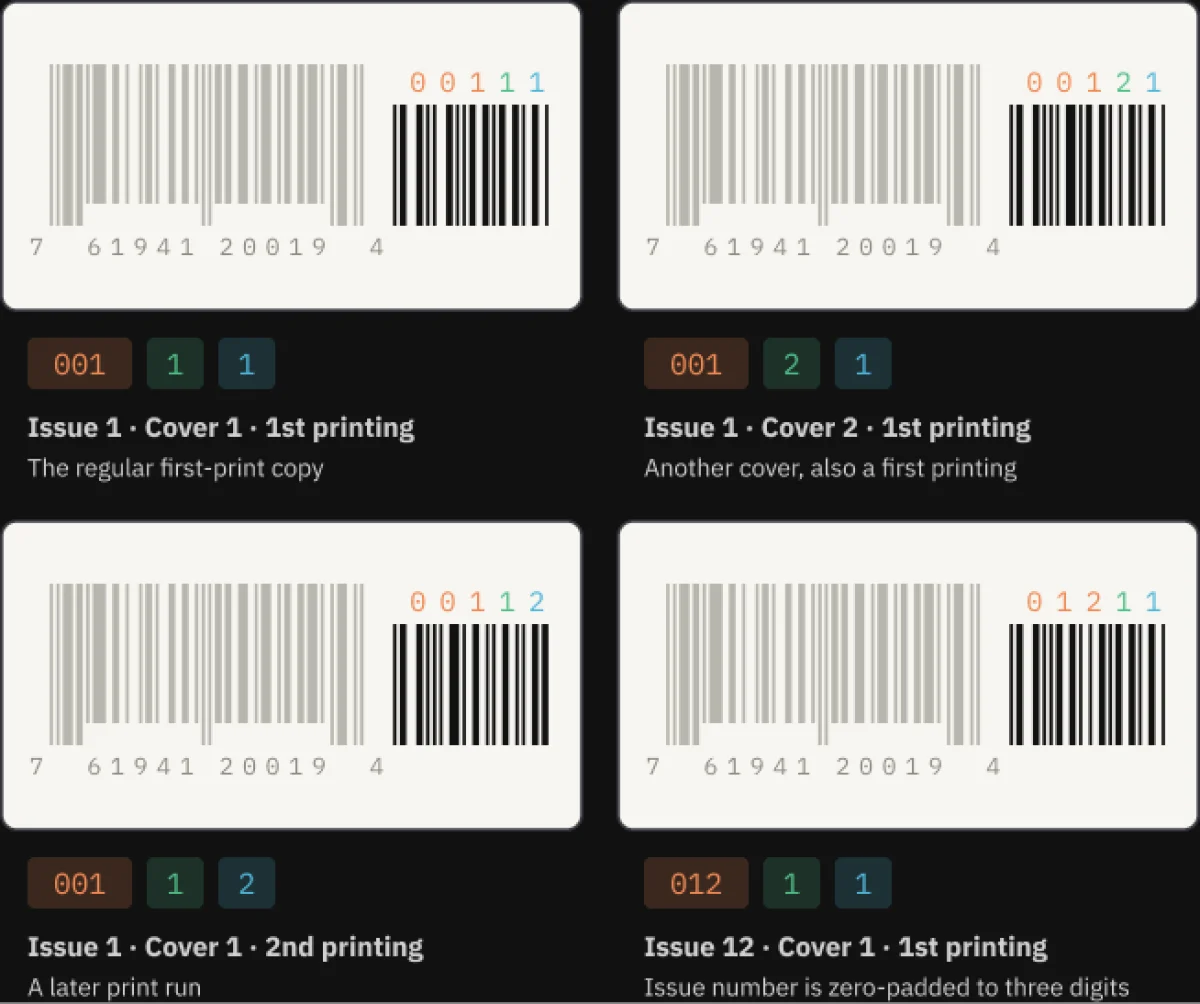
Newsstand vs. Direct Edition: How the Barcode Box Changed
Older newsstand and direct editions often look different in the barcode box. Many direct editions used a crossed-out barcode, a blank box, or publisher and character art where the newsstand copy had a scannable UPC.
But direct editions later gained barcodes too. CGC's illustrated guide shows both versions with UPCs by the mid-1990s, often with "Direct Edition" beside the shop copy's code. A barcode by itself doesn't prove that a comic is a newsstand edition.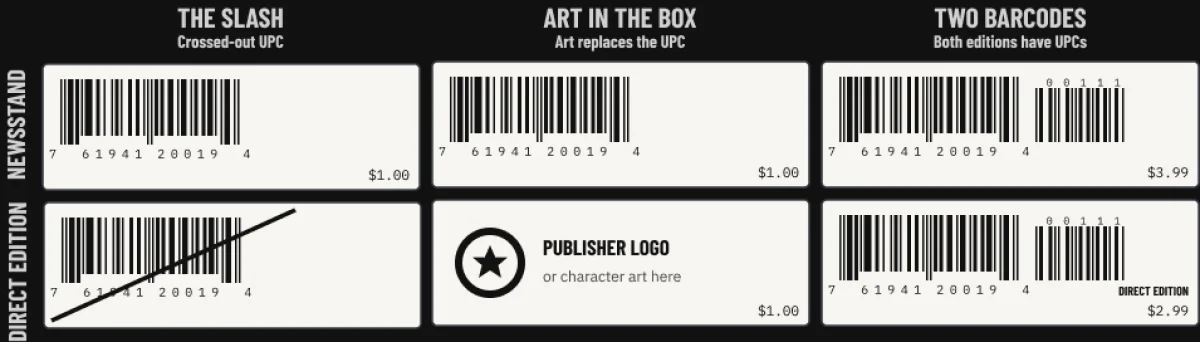
Trades and Graphic Novels Play by Different Rules
Collected editions, graphic novels, and hardcovers generally use an ISBN, shown in a 13-digit EAN "Bookland" barcode. Modern ISBNs begin with 978 or 979. An ISBN identifies a particular edition and format of a book; it isn't an issue-and-cover code.
Bowker is the ISBN agency for publishers based in the United States and its territories. Publishers elsewhere use the agency responsible for their location.
The ISBN barcode may have a five-digit add-on carrying price information. Under the Book Industry Study Group's US guidelines, 51999 means US$19.99, while 90000 means no price is encoded. The add-on is optional, although individual retailers may require it.
Don't assume a leading 6 means Canadian dollars: current BISG guidance gives 60000-89999 no pricing meaning. These book price codes follow different rules from the common issue, cover, and printing convention on single issues.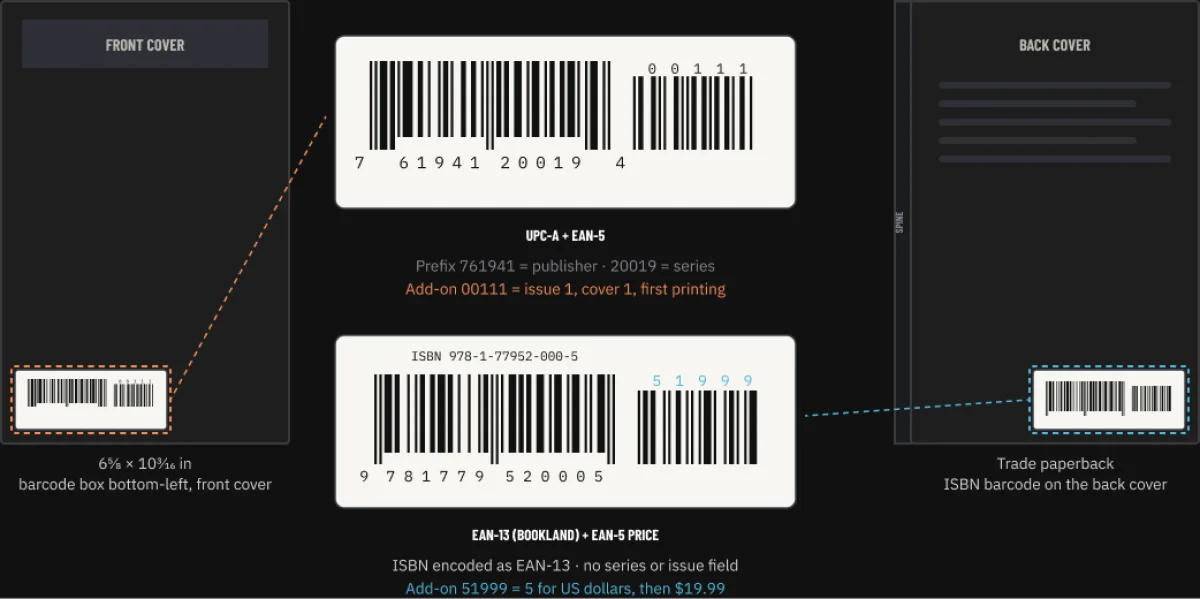
Why do some of my comics have no barcode at all?
Does the second barcode tell me the price?
What's the difference between a newsstand and direct edition barcode?
Why don't trade paperbacks have the same barcode as single issues?
Decode your comic’s barcode
Enter the numbers on your comic to explore what each part means.
Finding matching comics…
The catalog lookup is unavailable. You can still explore the barcode above.
About the author

Hey, I'm Michael! As the creator and developer behind VerseDB, I get to combine my love for building software with a serious comic book habit. While I enjoy collecting, I'm ultimately in it for the stories they tell. For me, it's all about getting lost in a great narrative and appreciating the artwork. I built this platform to give readers and collectors a clean, organized place to catalog the issues, runs, and art that mean the most to them. Log your favorites and welcome to the community!
Start tracking your collection
Track what you own and follow the series you read.
See what other collectors are picking up.