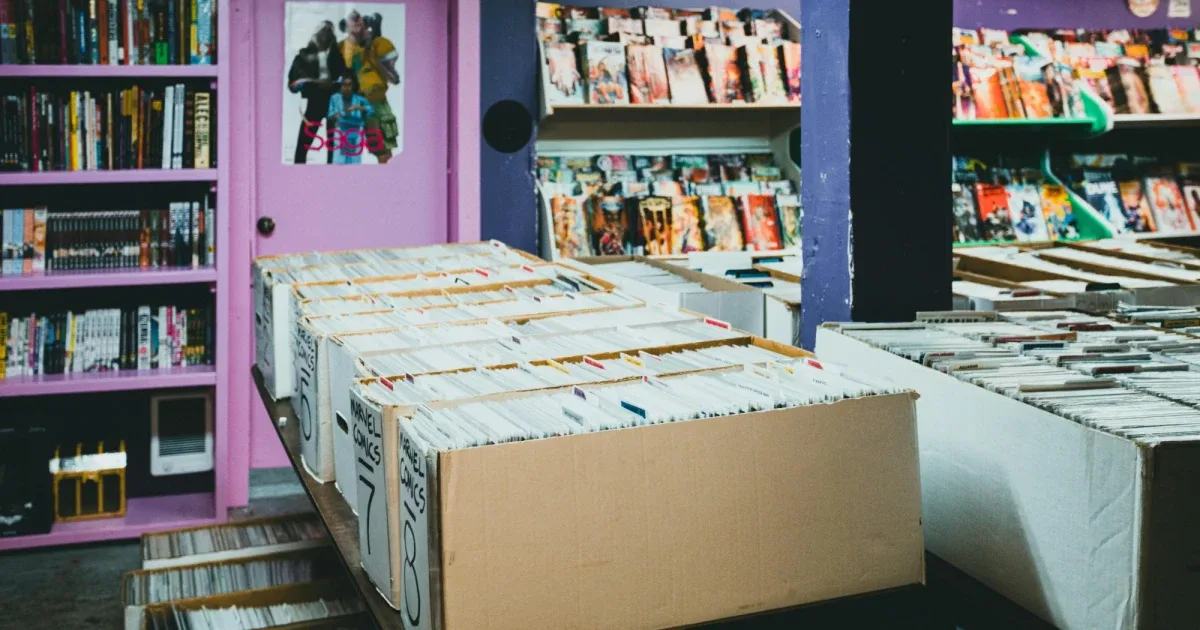
How Comic Books Are Distributed
How a comic book gets from the publisher to the reader has changed dramatically over the past century, and those changes have shaped everything from print runs to variant covers to the survival of local comic shops. Distribution is the invisible infrastructure behind every new release, every sell-out, and every back issue sitting in a dollar bin. Understanding how it works, and how it has evolved, gives collectors and readers essential context for why certain comics are scarce, why others are abundant, and why Wednesdays matter.
This section covers the major distribution models that have defined the American comic book market, from newsstands to the direct market to the digital storefront.
The Newsstand Era
For most of the 20th century, comic books were distributed through the same channels as magazines, newspapers, and paperback books. Publishers shipped comics to regional distributors, who placed them in general retail locations: grocery stores, drugstores, pharmacies, gas stations, newsstands, convenience stores, and five-and-dime shops. This was the newsstand distribution model, and it was the only way most Americans could buy comics from the late 1930s through the early 1980s.
Under the newsstand model, distribution worked on a returnable basis. Retailers did not pay upfront for the comics they received. Instead, a distributor placed copies on a spinner rack or magazine shelf, and the retailer paid only for copies that sold. Unsold copies were returned to the distributor (or, more commonly, the covers were stripped and returned as proof of unsold inventory while the remaining copies were pulped). This meant publishers absorbed the financial risk of overprinting, and retailers had no incentive to carefully curate their comic book inventory because unsold copies cost them nothing.
Key characteristics of newsstand distribution:
- Comics were sold alongside magazines and were treated as disposable periodical products, not collectibles
- Placement was unpredictable. A reader might find comics at one grocery store but not another, and the selection varied by region and distributor
- Print runs were enormous by modern standards. Popular titles in the 1960s and 1970s routinely shipped hundreds of thousands or millions of copies, knowing that a significant percentage would be returned and destroyed
- No pre-order system existed. Retailers received whatever the distributor sent them, and readers had no way to guarantee that a specific title would be available at their local store
- Return rates were high, often 40% to 60% of copies printed, meaning that for every comic sold, one or more copies were destroyed
The newsstand era gave comics their widest possible retail footprint. A kid in a small town with no bookstore could still find comics at the local pharmacy. But the model was inefficient for publishers, unpredictable for readers, and offered no mechanism for niche titles to find dedicated audiences. As the direct market grew in the late 1970s and 1980s, newsstand distribution shrank steadily. By the mid-2010s, most publishers had stopped producing newsstand editions entirely.
For collectors, newsstand editions from the 1980s onward are increasingly significant. As the direct market captured a larger share of distribution, the percentage of copies sold through newsstands dropped from roughly 50% in the early 1980s to under 10% by the 2000s. This makes later newsstand editions proportionally scarcer than their direct edition counterparts. Professional grading companies like CGC now note newsstand editions on their labels, and VerseDB tracks the newsstand variant distinction as part of its issue metadata, so collectors can identify and catalog both versions accurately.
The Direct Market
The direct market is the distribution system that transformed comic books from a mass-market magazine product into a specialty retail business. Under this model, comic book shops order comics directly from a distributor on a non-returnable basis. The retailer commits to purchasing a set number of copies before the comic is printed, and those copies cannot be sent back if they do not sell. In exchange for accepting this risk, retailers receive a higher discount on the cover price than newsstand accounts received.
The direct market emerged in the mid-1970s, pioneered by distributor Phil Seuling, who negotiated the first non-returnable distribution deals with Marvel and DC. Seuling's company, Sea Gate Distributors, offered comic book specialty shops a better margin in exchange for firm, non-returnable orders. This arrangement benefited everyone involved: publishers got more predictable sales data and reduced their return-related losses, retailers got better pricing and earlier access to new comics, and readers got a dedicated store where they could reliably find the titles they wanted.
The direct market changed the comic book industry in several fundamental ways:
- Comic book specialty shops became the primary retail channel, replacing newsstands, grocery stores, and pharmacies as the place where most comics were sold
- Pre-ordering became the standard. Retailers placed orders weeks or months in advance based on distributor catalogs (most notably Previews, the monthly catalog published by Diamond Comic Distributors), and those advance orders determined print runs
- Niche titles could survive. Under the newsstand model, a comic that sold 20,000 copies would be considered a failure. Under the direct market, that same title could be profitable because every copy was pre-sold to a retailer. This enabled creator-owned, independent, and genre-specific comics to find sustainable audiences
- Variant covers and incentive structures became possible because retailers were placing specific orders. Ratio variants, retailer exclusives, and tiered cover programs all depend on the direct market's pre-order system
- The relationship between retailer and customer became more personal. A comic shop owner who knew their customers' tastes could order accordingly, recommend titles, and build a community around the hobby
The shift from newsstand to direct market also created the direct edition vs. newsstand edition distinction that collectors track today. Comics distributed through the direct market carried different UPC codes and were sometimes identified by a logo or character image printed where the barcode would normally appear. This physical difference on the cover is how collectors (and databases like VerseDB) distinguish between the two distribution versions of the same issue.
By the early 1990s, the direct market accounted for the vast majority of comic book sales in the United States. The newsstand channel continued to shrink until it was functionally extinct for most publishers. Today, nearly all single-issue comic books sold in the U.S. are sold through the direct market, with bookstore and digital channels serving primarily collected editions and graphic novels.
Diamond, Lunar, and the Distribution Landscape
For nearly three decades, the direct market was functionally a monopoly controlled by a single company: Diamond Comic Distributors. Founded in 1982 by Steve Geppi in Baltimore, Maryland, Diamond grew through acquisitions and exclusive distribution agreements until, by the late 1990s, it was the only significant distributor of comic books to the direct market in North America. When its last major competitor, Capital City Distribution, was acquired by Diamond in 1996, the consolidation was complete. Every comic book specialty shop in the country ordered from Diamond or did not order at all.
Diamond's dominance meant that the company's catalog, Previews, was the single gateway through which retailers discovered and ordered new comics. Diamond's policies on minimum order thresholds, shipping schedules, and catalog placement affected which titles reached stores and which ones struggled to find shelf space. For small and independent publishers, meeting Diamond's minimum sales thresholds was a gatekeeping challenge that could determine whether a title survived or was cancelled.
This monopoly held until 2020, when DC Comics made a landmark decision to leave Diamond and establish new distribution partnerships:
- Lunar Distribution, operated by DCBS (Discount Comic Book Service) and Midtown Comics, became DC's exclusive direct market distributor in the United States
- Universal Distribution, operated by Penguin Random House, began distributing Marvel comics to the direct market starting in 2021, breaking Marvel's exclusive relationship with Diamond
When Diamond's operations were disrupted during the COVID-19 pandemic in early 2020, new comic distribution halted entirely for weeks, an event that accelerated DC's departure and Marvel's subsequent move to Universal. Diamond continued to distribute titles from Image, Dark Horse, BOOM!, IDW, and many other independent publishers, but the loss of DC and Marvel, its two largest accounts, proved fatal. Diamond filed for Chapter 11 bankruptcy in January 2025 and was converted to Chapter 7 liquidation in December 2025, shutting down permanently on December 31, 2025. The company that had controlled comic book distribution for nearly three decades ceased to exist.
Diamond's closure forced the remaining publishers to find new distribution partners. The direct market's distribution landscape is now split across multiple companies, with no single distributor holding the monopoly position that Diamond once occupied. Comic shop owners manage relationships with multiple distributors, placing separate orders through different systems for different publishers. The era of a single weekly shipment from one distributor is over.
Diamond's collapse has had ripple effects across the industry. For decades, a single Previews catalog was the only place retailers needed to look to order comics from virtually every publisher. That centralized system is gone. Independent publishers that relied on Diamond for distribution had to scramble for alternatives, and some smaller titles lost their primary path to comic shop shelves entirely. The bankruptcy also left publishers holding millions of dollars in consignment inventory trapped in Diamond's warehouses during the legal proceedings. On the other hand, the end of Diamond's monopoly has opened the door for new distribution models, including direct-to-retailer programs from publishers and the continued growth of bookstore distribution through Penguin Random House, which now serves both the book trade and the direct market for several major publishers.
For collectors and readers, the distribution landscape affects which comics reach shelves, how quickly sell-outs are identified, and how second printings are triggered. The pre-order numbers that retailers submit to distributors determine initial print runs, which in turn determine scarcity. A comic that sells out at the distributor level may never receive a second printing if the publisher does not believe sustained demand justifies one.
New Comic Book Day (Wednesday)
In the United States, new comic books arrive in stores on Wednesday. This weekly release schedule, known as New Comic Book Day (often abbreviated NCBD), is one of the defining rituals of the comic book hobby. Every Wednesday, comic shops receive their weekly shipment from distributors, stock the shelves with that week's releases, and open their doors to customers eager to pick up the latest issues.
Wednesday was not always the designated day. When the direct market first emerged in the late 1970s, new comics arrived on Fridays. By the early 1980s, the standard shifted to Thursday, and by 1988 it had moved up to Wednesday as distributors optimized their shipping schedules. Wednesday stuck because it gave shops time to receive Tuesday shipments, organize and stock the books, and open with a full display the next morning. The standardization brought consistency to a hobby that had previously seen comics arrive on different days depending on the distributor and the shop's location.
Wednesday's dominance was briefly disrupted in 2020 when DC Comics left Diamond and began distributing through Lunar Distribution, moving DC's release day to Tuesday to match the bookstore convention where new books ship on Tuesdays. For nearly four years, comic shops had a split schedule: DC on Tuesday, everyone else on Wednesday. DC moved back to Wednesday in July 2024 after sustained feedback from retailers and readers who preferred a single unified release day.
New Comic Book Day matters for several reasons:
- It creates a shared weekly experience among comic readers. Fans across the country read the same new releases on the same day, fueling online discussion, reviews, and social media engagement
- It establishes the official release date for every new comic, which is the date tracked by databases, sales charts, and collectors for determining first availability
- It drives weekly foot traffic to comic shops, making Wednesday the most important business day for many retailers
- It sets the rhythm for spoiler culture in comics. Reviews, plot discussions, and social media reactions typically begin on Wednesday afternoon, and readers who want to avoid spoilers know they need to pick up their comics early in the day
VerseDB tracks release dates on every issue in its database and organizes upcoming comics into a weekly releases view, so users can see exactly what is coming out each Wednesday. Browsing the weekly release calendar is one of the most practical ways to stay current with new comics and plan your weekly shop visit or pull list.
Beyond the weekly rhythm, the comic shop calendar includes one major annual event: Free Comic Book Day (FCBD). Held on the first Saturday in May since 2002, FCBD is a promotional event where participating comic shops give away specially produced free comics published by major and independent publishers. The event was created by retailer Joe Field to draw new readers into shops and generate public awareness of the medium. Publishers produce FCBD editions specifically for the event, often featuring previews of upcoming series, standalone stories, or sampler issues designed to hook first-time readers. FCBD has become one of the highest-traffic days of the year for comic shops, with many stores pairing the giveaway with sales, signings, and community events. For anyone curious about comics but unsure where to start, walking into a shop on Free Comic Book Day is one of the easiest ways to try the medium with zero financial commitment.
What Is FOC (Final Order Cutoff)?
FOC stands for Final Order Cutoff. It is the deadline by which comic book retailers must submit their final orders to a distributor before a comic goes to print. FOC typically falls two to three weeks before the comic's release date. After this deadline, retailers generally cannot increase their orders (though some distributors allow limited adjustments in specific circumstances).
FOC is the single most important date in the direct market ordering cycle because it determines the final print run for an issue. Every copy of a comic that will exist in its first printing is accounted for by the orders placed before FOC. If a book generates unexpected buzz after FOC, but before release, it may already be too late for retailers to order more copies. This is why certain issues sell out on release day despite high demand: the print run was locked in weeks earlier based on pre-FOC ordering patterns.
FOC affects collectors and readers in several practical ways:
- Scarcity is often determined at FOC, not on release day. A comic that retailers under-ordered at FOC may become an instant sell-out regardless of how many people want it on Wednesday
- Retailer awareness campaigns have become common. Publishers, creators, and fans use social media to promote upcoming books before FOC, urging readers to ask their local shop to increase orders
- Ratio variants are calculated against FOC orders. A 1:25 ratio variant is unlocked based on the retailer's total order at FOC, which means the scarcity of incentive variants is directly tied to the same ordering deadline
- Second printings are triggered when FOC orders and initial sell-through data indicate that demand exceeds supply, but the second printing itself goes through its own FOC cycle weeks later
For readers who follow upcoming releases, knowing the FOC date for a title you want is the best way to ensure your local shop orders enough copies. VerseDB tracks FOC dates on issues in its database, giving users visibility into when ordering deadlines are approaching. If you see a book on VerseDB with an FOC date coming up, that is your window to contact your shop or adjust your pull list before the print run is finalized.
What Is a Pull List?
A pull list is a standing order that a comic shop customer sets up with their local store. The customer provides a list of series they want to receive each month, and the shop sets aside copies of those titles as they arrive. When the customer visits the store, their reserved comics are waiting in a designated bin or folder, usually filed under their name or a customer number.
Pull lists are the direct market's answer to the unpredictability of the newsstand era. Instead of hoping that your local store happens to stock the titles you want, you tell the shop in advance, and they guarantee your copies. This benefits both parties: the customer never misses an issue, and the retailer has reliable demand data that informs their ordering.
How pull lists work in practice:
- The customer tells the shop which ongoing series they want to follow. Some shops also allow customers to add limited series, one-shots, and specific variant covers to their list
- Each week, the shop pulls copies of new releases that match the customer's list and sets them aside before the shelves open to general customers
- The customer visits periodically (weekly, bi-weekly, or monthly) to pick up and pay for their accumulated comics
- Most shops offer a discount to pull list customers, typically 10% to 20% off cover price, as an incentive for the guaranteed sales
- Customers can add or remove titles from their pull list at any time, though shops appreciate advance notice so they can adjust their distributor orders accordingly
Pull lists are one of the most important tools for both serious readers and collectors. For readers, a pull list ensures you never miss an issue of a series you are following. For collectors, it guarantees access to first printings on release day, which matters for titles that might sell out quickly.
VerseDB offers a digital Pull List feature that mirrors the comic shop experience. Users can add series to their pull list on the platform, and VerseDB surfaces upcoming releases for those series, organized by release week. Combined with the FOC dates and release dates tracked on every issue, the pull list feature gives you a complete view of what is coming, when ordering deadlines hit, and when your next comics will be available. Whether you use it alongside a physical shop pull list or as a standalone tracking tool, it keeps your reading schedule organized in one place.
Digital Distribution
While the direct market dominates single-issue sales, digital distribution has become a significant channel for comics, particularly for collected editions and backlist titles. Digital comics are sold and read through platforms and apps that deliver the content directly to a reader's device, bypassing physical production, shipping, and retail entirely.
The digital comics market grew steadily through the 2010s, driven by platforms like ComiXology (launched in 2007, acquired by Amazon in 2014), Apple Books, Google Play, and publisher-direct apps from Marvel and DC. Digital distribution offers several distinct advantages: instant access on release day without visiting a store, no physical storage requirements, the ability to carry thousands of comics on a single device, and frequent sales that make backlist titles available at steep discounts.
However, digital comics occupy a fundamentally different space than physical comics for collectors:
- Digital copies have no secondary market value. You cannot resell, trade, or grade a digital comic. You are purchasing a license to read the content, not a physical object you own
- Platform dependency means your library exists only as long as the platform does. When ComiXology merged its app into the Amazon Kindle ecosystem in 2023, users experienced changes to their reading experience and library access that they had no control over
- No variant collecting in the traditional sense. While some platforms offer exclusive digital covers, the concept of variant rarity does not translate to an infinitely reproducible digital file
- Simultaneous release is now standard. Most new comics release digitally on the same Wednesday as their print editions, meaning digital readers are no longer delayed relative to physical buyers
Digital distribution is covered in greater depth in Section 11, which examines digital platforms, webcomics, and international formats in detail. For the purposes of understanding distribution, the key point is that digital has expanded access to comics without replacing the direct market model that drives single-issue sales and the collecting hobby.
You're subscribed!
Thanks for joining our newsletter.
About the author
Hey, I'm Michael! As the creator and developer behind VerseDB, I get to combine my love for building great software with a serious comic book habit. While I definitely enjoy the thrill of collecting, I'm ultimately in it for the stories they tell. For me, it's all about getting lost in a great narrative and appreciating the artwork. I'm a massive fan of hunting down and showcasing beautiful covers. I built this platform to give readers and collectors a clean, organized place to catalog the issues, runs, and art that mean the most to them. Take a look around, log your favorites, and welcome to the community!
Your Comic Collection Awaits
Join thousands of comic enthusiasts tracking their collections,
discovering new series, and connecting with fellow fans.